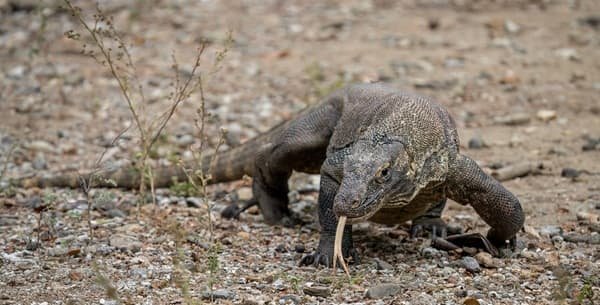
Komodo dragons are unlike the monitor lizards that sometimes appear in the exotic-pet trade. They are the world’s largest living lizards, can exceed 8 feet in length, and are protected internationally because of their conservation status. In the United States, that means the legal question is not simply whether a state allows large reptiles. Federal endangered-species law, international wildlife-trade rules, and state dangerous-animal laws can all apply at the same time.
For an ordinary person who wants a Komodo dragon as a household pet, legal ownership is generally not a realistic option. The species, Varanus komodoensis, is federally listed as endangered wherever found, and U.S. Fish and Wildlife Service policy makes clear that endangered-species permits and captive-bred wildlife registrations are intended for conservation-related purposes rather than pet keeping. Several states also independently prohibit or tightly restrict private possession.
Is the Komodo Dragon Federally Protected?
Yes. The U.S. endangered-wildlife list in 50 CFR 17.11 identifies the Komodo Island monitor, Varanus komodoensis, as endangered wherever found. The species has been federally listed since 1976.
The Endangered Species Act restricts activities such as import, export, interstate commercial sale, and other dealings involving listed wildlife unless an exception or permit applies. Possession by itself is not automatically an ESA violation when the animal was lawfully obtained, but acquiring, transferring, importing, or commercially moving an endangered Komodo dragon can trigger federal restrictions.
Can You Get a Federal Permit to Keep One as a Pet?
Federal endangered-species permits are not designed as exotic-pet licenses. U.S. Fish and Wildlife Service guidance states that its captive-bred wildlife program exists to support conservation breeding and enhancement of the species. The Service specifically says captive-bred wildlife permits are not issued to keep or breed endangered or threatened animals as pets.
That means a private buyer cannot simply apply for a routine federal pet permit and lawfully purchase a Komodo dragon for personal companionship. Zoos, conservation programs, researchers, and other qualified institutions operate under a very different legal framework.
Does CITES Affect Komodo Dragon Ownership?
Yes. Komodo dragons are listed in Appendix I of the Convention on International Trade in Endangered Species of Wild Fauna and Flora, or CITES. Appendix I contains species subject to the strictest international trade controls.
International movement therefore requires CITES documentation, and ordinary commercial trade in wild Appendix I animals is generally prohibited. CITES rules are especially important if an animal is being imported into or exported from the United States.
What Does Florida Law Say?
Florida classifies Komodo dragons as Class I wildlife because of the threat they can pose to human safety. Florida expressly states that Class I wildlife may not be possessed as a personal pet.
Qualified commercial or institutional applicants can seek Class I authorization for activities such as exhibition or sale, but they must satisfy substantial experience, facility, caging, acreage, financial-responsibility, and commercial-activity requirements. Florida therefore does not provide an ordinary private-pet path for a Komodo dragon.
What About New York and Massachusetts?
New York specifically lists the Komodo dragon among dangerous animals. The state dangerous-animal license may authorize possession for scientific, educational, exhibition, zoological, or propagation purposes, but New York expressly says the license does not allow a dangerous animal to be possessed as a pet.
Massachusetts is also restrictive. Its wildlife guidance states that federally listed lizards cannot be kept as pets, and it prohibits most monitor lizards except the spiny-tailed or ridge-tailed monitor. A Komodo dragon therefore does not qualify as an ordinary legal pet there.
Does Captive Breeding Make It Legal?
No. A captive-bred Komodo dragon is still Varanus komodoensis and remains federally endangered. Captive birth can matter for certain conservation permits, but it does not remove ESA, CITES, or state restrictions.
The U.S. captive-bred wildlife program can authorize certain otherwise prohibited activities when they enhance propagation or survival of the species. It is not a route for turning an endangered zoo animal into a private household pet.
What Happens if Someone Keeps One Illegally?
Violations can lead to seizure of the animal, civil penalties, criminal charges, and loss of wildlife permits. Federal endangered-species violations and state dangerous-animal offenses can apply at the same time, depending on how the animal was obtained, transported, sold, or possessed.
The Bottom Line
A Komodo dragon is not an ordinary legal pet in the United States. Federal endangered-species protection and CITES controls severely restrict acquisition, trade, import, and transfer, while states such as Florida, New York, and Massachusetts independently block normal private pet ownership.
Legitimate possession is mainly associated with zoos, conservation breeding, scientific institutions, and other specifically authorized programs. Captive-bred status does not create a pet-ownership loophole, and a person should not assume that legality in one jurisdiction overrides federal or state wildlife law.