No, caption phones are not illegal in the United States, but that’s true only for people with hearing loss who qualify for the service. Plain and simple! Going the other way around can surely put you in some legal danger, so just keep on reading to be clear about that.
So, What Exactly Is a Caption Phone?
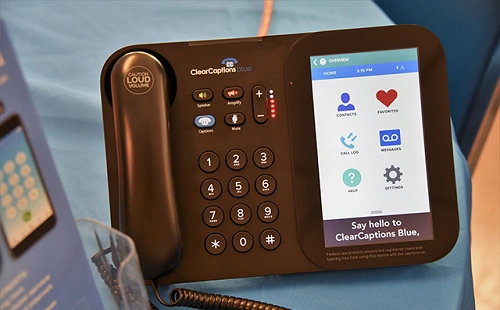
A caption phone initially looks like an ordinary home phone, but it has a screen that shows the words of the other party in the conversation instantly. The purpose of such a feature is mainly to assist people who can hardly hear the phone conversations clearly.
The person using the phone talks normally. However, the words that are being spoken by the other party, which are the source of the conversation, will be shown as captions on the display with a slight delay. To achieve this, the call audio is being sent through a captioning system. A system like this may operate through the involvement of trained captioning assistants, it may utilize speech recognition software, or it may use both methods to convert spoken words into written text. It is rather simple: giving people who are hard of hearing the phone conversation capability with minimal difficulty.
Why Caption Phones Are Legal in the U.S.
The reason why caption phones are legal is that they are derived from a federally supported accessibility program. In the United States, the Federal Communications Commission (FCC) regulates the aid services for people with hearing or speech impairments that enable them to communicate via phone. One of such a service is Internet Protocol Captioned Telephone Service, or IP CTS for short.
As IP CTS is a federal government’s initiative, the majority of states also back the idea of it. It’s even the case that some states operate facilities giving out caption phones for those who qualify. If both the federal and state governments are publicly in favor of and financing these services, the casing of caption phones themselves not being illegal is pretty evident.
Why Do Caption Phones Have Warning Stickers?
The warning stickers frequently cause the most confusion. These labels typically indicate that only registered users with hearing loss are allowed to access the captioning feature. The main thing is that the warning is not implying that the phone is against the law.
Captioning services are supported by a federal program that is dedicated only to helping people with hearing loss. Since public funds are used to pay for each minute of captioning, the law imposes strict regulations to avoid misuse.
When Using a Caption Phone Can Be Illegal
The only time using a caption phone can be a legal issue is when the non-hearing impaired person uses the captioning feature. For example, if a person who does not need captions switches them on merely to make the call more convenient, then it is considered a misuse of a service that is funded by the federal government.
People also raise concerns about privacy laws that are a misconception. As captioning may involve a third party or software that is used to process the audio of the call, people are worried about consent regulations. However, the federal law permits caption phone services for qualified users without exception. A non-eligible user or an unauthorized use of the service is when the problem arises.
Who Is Allowed to Use Caption Phones?
Basically, caption phones are devices for those with hearing impairments who require captions to talk on the phone. The main criterion is that a person needs to have the ability to understand others on the phone with the help of captions.
In most cases, the providers ask the customers to register and also verify that they have a hearing loss before starting the service. Often, people come across caption phones through a hearing doctor/ specialist. After the registration, the user has the right to use the captions whenever it is necessary.