Former U.S. Representative George Santos went to federal prison after pleading guilty to wire fraud and aggravated identity theft. The criminal case grew out of a broader federal investigation into campaign financing, misuse of donor information, unemployment benefits, and false financial disclosures connected to his political career.
Santos was sentenced on April 25, 2025, to 87 months in federal prison. The court also ordered him to pay $373,749.97 in restitution and $205,002.97 in forfeiture. He began serving the sentence in July 2025. However, he did not serve the full seven-year-plus term. President Donald Trump commuted Santos’ sentence on October 17, 2025, leading to his release.
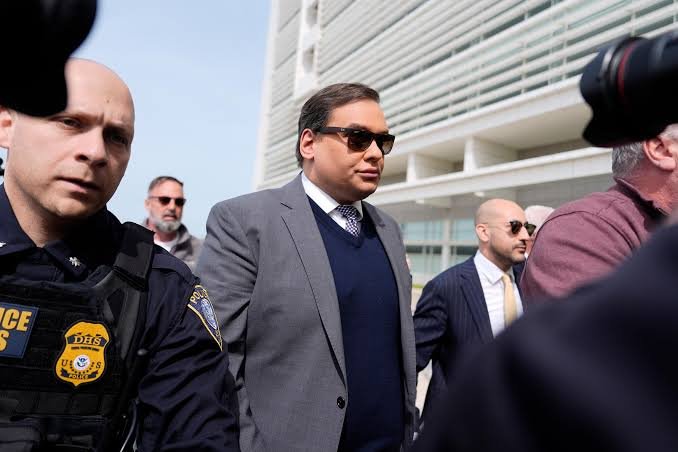
The key point is that Santos was not imprisoned simply because he had lied about parts of his biography. His prison sentence came from federal criminal conduct to which he pleaded guilty, particularly wire fraud and aggravated identity theft.
Why Was George Santos Sentenced to Prison?
Santos pleaded guilty in August 2024 in the U.S. District Court for the Eastern District of New York. His two guilty pleas were for wire fraud and aggravated identity theft.
Wire fraud generally involves using interstate electronic communications as part of a scheme to obtain money or property through fraud. Aggravated identity theft applies in certain federal cases when a person knowingly uses another person’s identity during and in relation to specified felony offenses.
Although Santos formally pleaded guilty to those two counts, his plea agreement also required him to accept responsibility for additional criminal conduct described by federal prosecutors. That conduct played a role in the sentencing process.
Fraudulent Campaign Finance Reports
One major part of the case involved reports filed with the Federal Election Commission during Santos’ 2022 campaign for Congress.
According to the Justice Department, Santos and his campaign treasurer, Nancy Marks, agreed to make the campaign appear more financially successful than it really was. Prosecutors said false fundraising figures were reported to the FEC so the campaign could qualify for financial and logistical support from a national political party program.
The campaign needed to demonstrate that it had raised at least $250,000 from third-party contributors during a particular quarter. Federal prosecutors said Santos and Marks falsely reported contributions attributed to family members who had not actually made those donations.
They also reported that Santos had loaned substantial amounts of money to his campaign. One reported loan was $500,000, even though prosecutors said Santos had less than $8,000 in his personal and business bank accounts at the relevant time.
The government said those false reports helped the campaign meet fundraising benchmarks that made it eligible for additional political support.
Unauthorized Charges on Donors’ Credit Cards
The criminal case also included a scheme involving campaign donors’ identities and credit cards.
Federal prosecutors said Santos obtained personal identity and financial information belonging to contributors and then repeatedly charged their credit cards without authorization. Some of the money went to political campaigns, while other funds were transferred for Santos’ benefit.
Prosecutors also said names of relatives and associates were used in campaign finance filings to disguise the real source of certain contributions and to avoid contribution limits.
The Justice Department stated that some victims were elderly people experiencing cognitive decline. Santos admitted relevant conduct as part of his guilty plea and sentencing agreement.
Using Political Donations for Personal Expenses
Another part of the case involved money solicited from political supporters.
During his 2022 congressional campaign, Santos operated a limited liability company that prosecutors said was used to collect money from prospective donors. According to the government, donors were told that their money would help elect Santos, including by paying for television advertising.
Two donors each transferred $25,000. Prosecutors said the money was then moved into accounts controlled by Santos and used for personal purposes.
The Justice Department said those expenses included designer clothing, cash withdrawals, personal debts, and transfers to associates. This conduct formed part of the wider fraudulent activity Santos acknowledged in the plea agreement.
Unemployment Benefits Fraud
Santos also admitted conduct involving unemployment insurance benefits.
Federal prosecutors said Santos applied for and received unemployment benefits during the COVID-19 pandemic while he was employed by a Florida-based investment firm and earning a salary.
According to the Justice Department, he received more than $20,000 in unemployment benefits to which he was not entitled.
This conduct was not the sole reason for the prison sentence, but it was among the additional criminal activity considered by the court when determining punishment.
False Financial Disclosures to the House
Santos’ case also involved false statements about his finances in disclosures associated with his congressional campaign and service.
Federal prosecutors said Santos falsely reported large amounts of income and bank deposits. Among other things, he claimed to have received substantial salary and dividend income from his company and to hold bank accounts containing large balances.
The government said those representations were false. Prosecutors also said he failed to disclose other income and unemployment benefits.
These false financial disclosures were part of the broader pattern of conduct described in the federal case.
How Long Was George Santos Sentenced to Prison?
On April 25, 2025, U.S. District Judge Joanna Seybert sentenced Santos to 87 months in federal prison, equivalent to seven years and three months.
The sentence also required $373,749.97 in restitution to victims and $205,002.97 in forfeiture.
Santos had pleaded guilty rather than going through a full criminal trial. The guilty plea meant he formally admitted the offenses of wire fraud and aggravated identity theft and accepted responsibility for the additional conduct set out in his agreement with prosecutors.
The 87-month sentence was substantially longer than the mandatory two-year term associated with the aggravated identity theft count alone because the court considered the broader fraud conduct and the applicable federal sentencing framework.
Was George Santos Expelled From Congress Because of the Criminal Case?
Santos was expelled from the U.S. House of Representatives on December 1, 2023. His removal from Congress happened before his guilty plea and prison sentence.
The expulsion followed a House Ethics Committee investigation that described extensive evidence of campaign-related misconduct and misuse of funds. The criminal prosecution was a separate federal process.
That distinction matters. Congress has its own constitutional authority to discipline and expel members, while federal courts determine criminal guilt and punishment. Santos’ expulsion therefore did not itself send him to prison.
Did George Santos Go to Jail for Lying About His Background?
Not directly.
Santos became nationally known after reports showed that he had made false claims about parts of his education, employment history, family background, and personal biography. Those revelations damaged his public credibility and contributed to intense political scrutiny.
But exaggerating or lying about a résumé is not automatically a federal crime. His prison sentence came from the financial fraud and identity theft case prosecuted by the U.S. government.
The distinction is important because public controversy and criminal liability are not the same thing. The conduct that resulted in the prison sentence involved money, campaign reporting, unauthorized credit-card charges, identity information, unemployment benefits, and financial disclosures.
Why Was George Santos Released Early?
Santos began serving his federal prison sentence in July 2025, but his incarceration ended only a few months later.
On October 17, 2025, President Donald Trump commuted the remaining prison sentence. A commutation reduces or ends a criminal sentence but is different from overturning the conviction itself.
Trump publicly described the punishment as excessively harsh. Following the commutation, Santos was released from federal custody.
As a result, saying that Santos is currently serving an 87-month prison sentence would be inaccurate. He was sentenced to 87 months and did begin serving that term, but the remaining imprisonment was later commuted by presidential clemency.
Did the Commutation Erase George Santos’ Conviction?
A commutation generally changes the punishment rather than wiping away the conviction.
Santos’ guilty plea to wire fraud and aggravated identity theft therefore remains an important part of the legal record. The presidential action ended the remaining prison term, but it was not the same as a judicial finding that the prosecution was invalid.
This is also different from a full pardon, which can carry broader legal effects. The October 2025 action concerning Santos was reported as a commutation of his sentence.
Conclusion
George Santos went to federal prison because he pleaded guilty to wire fraud and aggravated identity theft after a federal investigation into fraudulent campaign activity and misuse of other people’s personal and financial information.
The case included false FEC reports, unauthorized charges to campaign donors’ credit cards, misuse of donor money, fraudulent unemployment benefits, and false financial disclosures. A federal judge sentenced him to 87 months in prison in April 2025 and ordered substantial restitution and forfeiture.
However, Santos did not serve the full sentence. After beginning his prison term in July 2025, he was released following President Donald Trump’s October 17, 2025 commutation.
So the accurate summary is straightforward: Santos was imprisoned for federal fraud and identity theft offenses, not simply for making false claims about his personal history.