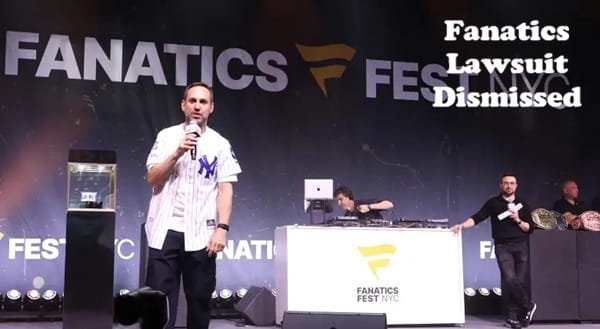
A major antitrust lawsuit challenging Fanatics’ growing control of the U.S. professional sports trading-card market has been dismissed in federal court. On September 29, 2026, Chief U.S. District Judge Laura Taylor Swain of the Southern District of New York dismissed the proposed class action in Jones v. Fanatics, Inc. after concluding that the named plaintiffs had not shown the concrete, personal injury required to establish standing in federal court.
The case targeted Fanatics along with Major League Baseball, the National Football League, the National Basketball Association, several players associations, and OneTeam Partners. The plaintiffs accused the defendants of helping Fanatics build an unlawful monopoly through long-term exclusive licensing arrangements and other allegedly anticompetitive practices. The dismissal, however, turned on a threshold constitutional issue rather than a final ruling on whether Fanatics violated federal antitrust law.
What Was the Fanatics Lawsuit About?
The lawsuit was brought by a group of sports-card consumers who sought to represent a larger class of buyers. Their amended complaint contained 13 counts and relied heavily on the Sherman Act and Clayton Act, the two principal federal statutes governing anticompetitive conduct and mergers.
The plaintiffs alleged that Fanatics obtained long-term exclusive trading-card licenses involving MLB, the MLB Players Association, the NBA, the National Basketball Players Association, the NFL, and the NFL Players Association. They also challenged Fanatics’ acquisition of Topps and its investment in GC Packaging, a manufacturer that had supplied Fanatics competitor Panini America.
According to the complaint, these moves gave Fanatics increasing control over the production and sale of fully licensed professional sports trading cards in the United States.
What Did the Plaintiffs Accuse Fanatics of Doing?
The plaintiffs claimed that Fanatics used exclusive licensing agreements and other business practices to reduce competition in the trading-card market. Among other allegations, they said the company’s market position could lead to higher prices, fewer choices, reduced output, and lower-quality products.
The complaint also alleged that Fanatics pressured retailers and other market participants, interfered with Panini’s business, and used its licensing position to strengthen its control of the market. These were allegations made by the plaintiffs and were not established as facts by the court.
Why Did the Federal Court Dismiss the Lawsuit?
The decisive issue was Article III standing. Under the U.S. Constitution, a plaintiff asking a federal court to decide a dispute must show an actual or sufficiently imminent personal injury that can be connected to the defendant’s conduct and potentially remedied by the court.
Judge Swain found that the named plaintiffs had not pleaded enough specific facts showing that they themselves suffered such an injury. The complaint generally stated that the plaintiffs had purchased professional sports trading cards, but it did not provide adequate detail about which products they bought, how much they paid, when or where they bought them, or how the alleged anticompetitive conduct directly harmed those particular purchases.
The court therefore granted the defendants’ motions to dismiss under Federal Rule of Civil Procedure 12(b)(1), which allows dismissal when a federal court lacks subject-matter jurisdiction.
Higher Prices Were Not Sufficiently Tied to the Named Plaintiffs
One of the plaintiffs’ main theories was that Fanatics’ alleged market power caused consumers to pay prices above competitive levels. To support that theory, the complaint referred to online discussions, including Reddit posts and a YouTube podcast, in which collectors complained about trading-card prices.
The court found that those third-party accounts did not establish that the named plaintiffs personally paid an unlawfully inflated price. The judge noted that the complaint lacked specific allegations about the prices actually paid by the named plaintiffs and did not provide market-wide economic analysis demonstrating that supracompetitive pricing was so widespread that injury to the plaintiffs could reasonably be inferred.
Claims About Reduced Choice and Product Quality Also Failed
The plaintiffs also alleged that Fanatics’ conduct reduced consumer choice, disrupted output, and contributed to lower-quality cards. But the court again focused on the absence of individualized injury.
For example, the plaintiffs did not adequately allege that a named plaintiff was personally unable to buy a specific card because of reduced output or that a card purchased by a named plaintiff suffered from the quality problems described in outside reports. General claims about conditions in the broader marketplace were not enough to establish the required personal injury.
NFL Trading Card Claims Had an Additional Standing Problem
The court separately noted that none of the named plaintiffs was alleged to have purchased NFL trading cards. Without a past purchase or sufficiently concrete future injury involving those products, the plaintiffs could not establish standing to pursue claims based on alleged harm in the NFL card market.
Court Did Not Decide Whether Fanatics Violated Antitrust Law
This distinction is legally important. The dismissal should not be read as a judicial finding that every challenged Fanatics licensing arrangement or business practice complies with antitrust law.
Because the court found that the plaintiffs lacked standing, it did not need to decide the full merits of their Sherman Act, Clayton Act, state-law, and unjust-enrichment claims. In other words, the lawsuit failed because the particular plaintiffs did not sufficiently show that they were legally entitled to ask the federal court to decide those claims.
What Happened to the Arbitration Requests?
Fanatics and several other defendants had also asked the court to compel certain plaintiffs to arbitration. Once the court dismissed the case for lack of standing and subject-matter jurisdiction, those arbitration motions no longer required a decision. The judge denied them as moot.
What Does the Fanatics Lawsuit Dismissal Mean?
For Fanatics and the other defendants, the ruling ended this federal class action at the district-court level and resulted in judgment being entered in their favor. For consumers and antitrust litigants, the decision is a reminder that broad allegations of monopoly power are not enough by themselves to maintain a federal class action.
A named plaintiff must connect the alleged antitrust conduct to a concrete personal injury. That may require detailed purchase information, pricing evidence, product-specific allegations, or economic data showing how the challenged conduct caused measurable harm.
The ruling also demonstrates the importance of standing in U.S. class-action litigation. Before a federal judge reaches difficult questions about monopoly power, exclusive licensing, or anticompetitive conduct, the plaintiffs must first satisfy the constitutional requirement that they personally suffered an injury the court has authority to address.
Legal Note
This article is for general informational purposes and summarizes a federal court ruling. It is not legal advice. Court rulings may be appealed, and later proceedings can affect the status or interpretation of a case.