You remember the light turning yellow. You were braking before the intersection. The other driver says you sailed through fast without easing off, and now both insurers are untangling two conflicting stories. Car black box data can check those accounts against a record of vehicle activity. What it captures is brief, just a short stretch around the crash. The decisions that put two vehicles at that intersection came earlier, and those stay off the record. That gap can matter once Ohio law starts dividing responsibility between drivers.
This guide is general information, not legal advice for your claim.
What a Car’s Black Box Actually Records
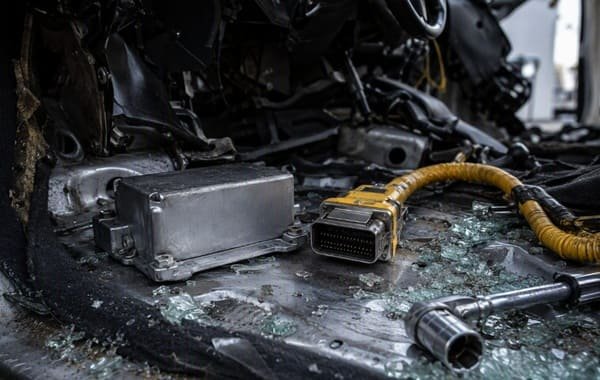
An event data recorder, or EDR, saves a brief stretch of vehicle activity around a triggering event. People call it a “black box.” The function usually lives inside the airbag control module; there is no separate recorder tucked under a seat.
And it isn’t dashcam footage. What an EDR records depends on the vehicle:
- Vehicle speed
- Brake application
- Accelerator or throttle position
- Change in velocity, called delta-V, meaning how much the vehicle’s speed changes during impact
- Seat-belt status
- Airbag timing
Design and model year determine which fields your vehicle offers, as does the event that triggered the recording. The EDR won’t capture conversations, distractions, weather, or road debris.
Under NHTSA’s current EDR implementation rule, covered new vehicles must expand the pre-crash recording window from five seconds to 20, with full phase-in set for September 1, 2031. Your existing car might still capture only the shorter window.
Do Most Cars Have Event Data Recorders?
Nearly all recent passenger vehicles have EDR capability. Older models often record less, some record nothing. Look in your owner’s manual for an EDR disclosure. Then pull together the VIN and vehicle specs, model year included. A qualified crash-data technician can tell you if retrieval equipment exists that works with that vehicle.
How Electronic Evidence Can Change Fault in an Ohio Collision
Black box evidence lets recorded vehicle activity put driver accounts to the test. Because modern vehicles quietly record seconds of data, the download may help test conflicting claims about speed, braking, or accelerator use. Gaps can leave a disputed action unsettled, like braking that started outside the recorded window.
Ohio recovery is barred when fault goes above half.
Ohio Revised Code §§ 2315.33 and 2315.34 govern how a claimant’s share of responsibility affects a case. A claimant recovers only if that share stays no greater than the combined share assigned to others, and the award then shrinks in proportion to the claimant’s responsibility. Fault above half, usually put at 51% or more, bars recovery. If every other legal requirement were met, $100,000 in damages and 20% claimant fault would produce an $80,000 award.
What Other Evidence Belongs in the Comparison?
EDR information is strongest when compared with physical evidence and independent records. Scene photographs and measurements can reveal sight obstructions or tire marks. Damage patterns can help establish impact direction and severity.
Witnesses may remember the traffic signal, though memory can be mistaken. Police reports organize observations and statements without settling civil fault. Medical records document injuries and their timing, not which driver entered the intersection first.
Getting Black Box Data After a Car Accident
You usually need lawful access to the vehicle and a technician with compatible equipment. The usual sequence:
- Locate every involved vehicle and its current storage site.
- Arrange preservation before repairs or disposal affect the vehicle or module.
- Determine who owns the vehicle and controls access.
- Have a qualified technician retrieve the data with compatible equipment.
- Retain the original file and reports, plus photographs and handling records.
Who can access a vehicle’s event data recorder?
The Driver Privacy Act of 2015, codified at 49 U.S.C. § 30101 note, generally treats EDR data as the property of the vehicle’s owner or lessee. Others may retrieve it with consent or qualifying judicial or administrative authorization. The law includes limited exceptions for certain safety investigations and emergency medical responses.
This federal law governs ownership and retrieval, not Ohio fault allocation. Reaching another driver’s vehicle may take consent or legal process. A subpoena doesn’t guarantee immediate physical access to a car sitting in a tow yard, either.
What pulling the data costs
Ohio sets no official rate. Diagnostic-port access involves less work than module removal, and equipment compatibility can complicate retrieval. Travel and storage can add charges. Ask for a written scope that separates retrieval from interpretation and prices any testimony separately.
How Long Black Box Data Survives After a Crash
No universal retention period applies. Some qualifying airbag-deployment events may be locked, while non-deployment records may be overwritten or cleared. Continued driving can affect availability in some vehicles.
Repairs or module replacement can change what remains accessible. A salvage transfer can make the vehicle harder to locate. Battery disconnection doesn’t erase stored events, but destruction of the module ends access to the data.
Preserve the data before the filing deadline matters
Ohio generally sets a two-year deadline for filing a personal injury claim, but the practical window for preserving evidence is a completely different clock. A vehicle can be repaired, sold, transferred, or crushed long before a lawsuit must be filed. Prompt preservation protects access to information that would otherwise be lost.
Why Documentation and Expert Interpretation Matter
Holding an EDR file doesn’t establish what it means. Reliable documentation shows where the file came from, how it was retrieved, and whether the vehicle or module changed before testing.
What a chain of custody should show
Chain of custody is the record of who handled the evidence. It should name the vehicle’s custodians and the person who downloaded the data, including the hardware and software used. Records should track module removal, file copying, and changes to the vehicle or module before testing.
Why interpretation matters
A raw report contains readings; an expert explains their significance. A trained technician retrieves the file, but a qualified reconstruction professional interprets its meaning. That includes vehicle-specific definitions, timing, and measurement limits. Reconstruction tests whether the electronic readings fit the collision’s physical evidence, such as vehicle damage and tire marks. A speed entry recorded before impact isn’t necessarily the vehicle’s speed at the moment of contact.
What Black Box Data Gets Wrong or Leaves Out
Objective doesn’t mean complete. EDR data provides a snapshot, not a replay. Missing fields and events outside the recording window leave gaps, including a steering maneuver that began earlier.
A recorded brake application can’t explain why the driver pressed the pedal, either. An animal, road debris, or a blocked sightline might explain an action without appearing anywhere in the downloaded report.
Frequently Asked Questions About Car Black Box Data
Can I remove an EDR from my car?
Never yank out or tinker with a module after a crash. Because the EDR function often lives inside the airbag control module, rough handling can wreck safety equipment or evidence. If crash damage blocks the diagnostic port, a trained technician might have to pull the module to reach the data.
Can black box data prove speeding?
It can supply evidence of pre-impact speed. It doesn’t prove a speeding violation or sole fault by itself. Crash analysts must weigh the posted limit and the timing of each reading. Tire size, wheel slip, calibration, and vehicle movement during impact can all affect the interpretation.
A brake-on reading doesn’t establish hard braking, either. That question calls for deceleration measurements and physical evidence, such as tire marks.
Do insurance companies check EDR data?
Insurers may seek a download when fault or crash severity is disputed, including when investigating potential insurance fraud. They don’t request one after every collision, and insurer interest doesn’t substitute for consent or other legal authority to access the vehicle.
Can the data carry a claim by itself?
Usually not. EDR data may settle a narrow factual dispute, but legal responsibility still needs context. Damages need separate proof, such as treatment records and lost-income documentation. A speed value can’t show the color of the traffic light.
What Ohio Drivers Should Remember About EDR Evidence
Prompt preservation can protect access to car black box data, but ownership doesn’t settle its interpretation or use in a claim. In Ohio, the download may influence how fault is divided. Its value rests on how well those recorded seconds fit the rest of the crash record, including the physical evidence at the intersection.