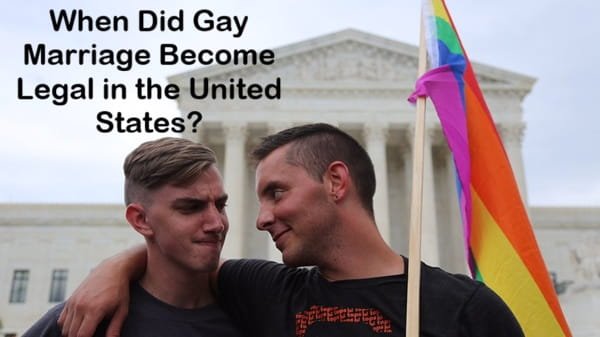
Same-sex marriage became legal throughout the United States on June 26, 2015, when the Supreme Court decided Obergefell v. Hodges. The Court held that the Fourteenth Amendment requires states both to license marriages between two people of the same sex and to recognize valid same-sex marriages performed in other states. The decision ended the patchwork in which couples could legally marry in one state but be denied a marriage license or recognition in another.
The nationwide ruling was the culmination of many state lawsuits, legislative changes, and earlier Supreme Court decisions. It was not the first time a same-sex couple could legally marry in America.
When Was Same-Sex Marriage First Legal in a State?
Massachusetts became the first U.S. state to allow same-sex couples to marry, beginning May 17, 2004. That change followed the Massachusetts Supreme Judicial Court’s 2003 ruling in Goodridge v. Department of Public Health, which found that excluding same-sex couples from civil marriage violated the state constitution.
During the following decade, additional states recognized marriages through court rulings, legislation, and voter-approved measures. Some states later adopted bans through statutes or constitutional amendments. The resulting conflicts meant that a couple’s marriage rights could change when crossing state lines, particularly concerning benefits, inheritance, taxation, or legal parenthood.
What Happened Before the 2015 Supreme Court Decision?
Two earlier federal developments shaped the path to nationwide marriage equality. In 1996, Congress enacted the Defense of Marriage Act (DOMA). Its federal-definition provision treated marriage, for federal-law purposes, as a union between a man and a woman. Another provision addressed whether states had to recognize same-sex marriages from elsewhere.
In United States v. Windsor, decided June 26, 2013, the Supreme Court struck down DOMA’s federal definition as unconstitutional in the circumstances before it. The ruling helped married same-sex couples obtain federal recognition where their marriages were lawful, but it did not require every state to issue marriage licenses. State-level disputes continued.
What Did Obergefell v. Hodges Decide?
In Obergefell, the justices considered cases involving couples from Michigan, Kentucky, Ohio, and Tennessee. Those states had refused either to issue licenses to same-sex couples or to recognize marriages legally performed elsewhere. On June 26, 2015, the Court ruled 5-4 that these restrictions violated the Fourteenth Amendment’s guarantees of due process and equal protection.
Justice Anthony Kennedy wrote the majority opinion. The ruling required every state to license and recognize marriages between two people of the same sex under the same basic civil-marriage framework used for opposite-sex couples. It did not eliminate ordinary requirements concerning age, consent, prohibited family relationships, or existing marriages.
The result was immediate nationwide legal recognition. Same-sex couples no longer had to depend on whether their state had separately approved marriage equality through a legislature, a referendum, or a state court.
Did the Law Change Again in 2022?
Yes. On December 13, 2022, the Respect for Marriage Act became federal law. It repealed remaining DOMA provisions and established statutory protections for recognition of valid marriages between two individuals, including same-sex and interracial marriages. It also addressed federal treatment of marriages valid where entered into.
The 2022 law and the 2015 Supreme Court decision perform different functions. Obergefell requires states to issue licenses and recognize same-sex marriages as a constitutional matter. The Respect for Marriage Act provides important statutory recognition protections, but it is not an exact replacement for the entire constitutional holding if the Supreme Court were ever to revisit Obergefell.
The Act also contains specific protections for religious organizations in relation to providing certain wedding services. Its provisions must be understood as written rather than treated as a general exemption from every nondiscrimination rule.
Is Same-Sex Marriage Still Legal in 2026?
Yes. Obergefell remains binding precedent as of November 2026, and the Respect for Marriage Act remains in force. In November 2025, the Supreme Court declined to hear an attempt to challenge the Obergefell ruling in litigation involving a former Kentucky county clerk. Denial of review did not create a new precedent, but it left the existing nationwide ruling undisturbed.
A couple seeking marriage in 2026 follows its state’s ordinary license and solemnization procedures. Married couples generally have access to legal protections involving federal taxes, Social Security eligibility, inheritance, and other spousal rights, subject to the requirements of each program.
The Key Date
The correct date for nationwide legalization is June 26, 2015. Massachusetts had permitted same-sex marriage since May 17, 2004, and several other states followed before 2015. The 2022 Respect for Marriage Act added statutory recognition protections, but the Supreme Court’s Obergefell decision remains the landmark that made marriage equality a nationwide constitutional requirement.