An October 15, 2026, immigration enforcement stop in Sanford, Maine, ended with a vehicle collision, the detention of a driver and emergency attention for his one-year-old child. The incident drew competing interpretations of the agents’ tactics and the driver’s actions. Understanding the event requires separating the police account, eyewitness observations and legal questions that had not been resolved by a court.
What happened during the Sanford stop?
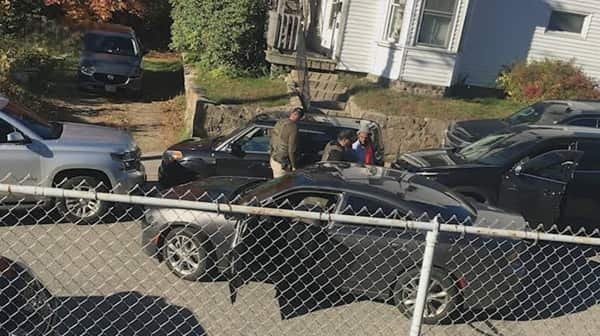
The Sanford Police Department said federal immigration agents stopped a vehicle on Brook Street near High Street shortly after 9 a.m. Agents reportedly positioned one vehicle ahead of the driver’s SUV and another behind it. As the driver reversed, his SUV struck the federal vehicle behind him.
A neighborhood video captured part of the encounter. Local reporting described the collision as occurring at low speed, with little vehicle damage. Sanford police responded after ICE requested assistance. Federal agents conducted the immigration enforcement action; local officers said they were called in after the crash.
Subsequent reporting identified the driver as Manucho Nseka, originally from Angola. The public accounts did not establish a criminal conviction stemming from the incident. Descriptions such as “ramming” or “attack” should not be used as findings of guilt simply because they appeared in an early allegation.
What happened to the children?
Officials said a one-year-old child was in the back seat of the SUV and was not properly secured in the car seat. Emergency personnel examined the child, who was taken for a medical evaluation as a precaution. Authorities reported no injuries from the collision.
Police also learned that the man’s other children, ages two and nine, were at a nearby home without adult supervision. State child-welfare officials were contacted, and local reporting said the older children were later placed with a family friend.
The presence of children makes the safety questions particularly serious. It does not, however, establish that any particular officer or parent violated the law without an examination of the applicable facts and legal duties.
Can immigration agents conduct vehicle stops?
Immigration officers have statutory authority to make certain arrests and conduct investigations, but stops and seizures remain subject to constitutional and statutory limits. The Fourth Amendment’s protections apply to traffic stops and vehicle seizures. An officer’s ability to make an immigration arrest without a judicial warrant depends on specific legal conditions rather than a general power to stop any vehicle at will.
Whether agents had reasonable suspicion for a stop, a valid basis for an arrest and lawful authority for the manner in which they blocked the SUV would require facts not established by the published video alone. Officers’ safety concerns and any driver’s conduct during an encounter would also be relevant.
How does the collision affect the case?
A driver’s actions during a stop may produce separate traffic or criminal inquiries, but a collision does not automatically prove intentional assault on a federal officer. Prosecutors would need to establish the elements of any charge, including any required mental state. Conversely, allegations of an unlawful stop do not give a driver unlimited legal authority to endanger others while escaping.
In a civil-rights challenge, investigators might examine body-camera footage, federal vehicle recordings, dispatch records, the timing of commands and eyewitness statements. The short neighborhood clip captures only a portion of the incident and cannot settle every disputed question.
Why local and federal roles matter
Federal immigration enforcement and local police response are not identical functions. Sanford officers’ role in evaluating the collision and helping children does not by itself mean they initiated or directed the immigration stop. Responsibility for each action depends on which agency performed it and under what legal authority.
What is known as of November 2026?
The supported facts are a federal vehicle stop, a low-speed collision, the driver’s immigration detention, medical evaluation of a toddler and child-welfare assistance. Reports differed in tone and in the conclusions they drew about enforcement tactics.
A responsible legal account should neither declare the driver guilty of assault nor declare the federal agents liable for an unlawful seizure without a court ruling. The incident raises legitimate constitutional and child-safety questions, but the ultimate legal outcomes depend on evidence and any subsequent proceedings.