Choosing the right business structure is one of the first serious decisions an entrepreneur makes. It affects taxes, ownership control, compliance, and even how investors view your company. In the United States, the two most commonly used structures for liability protection are the Limited Liability Company (LLC) and the Corporation (C-Corp or S-Corp).
At a glance, both protect personal assets. But when you look deeper, the differences are significant and practical. Let’s break them down clearly.
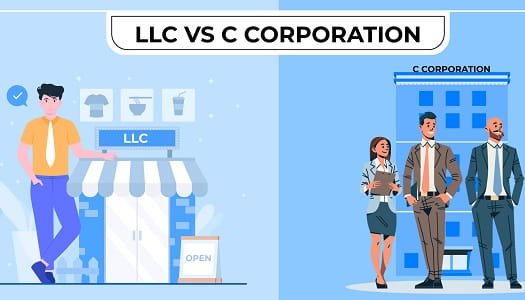
1. Legal and Structural Differences
The biggest difference between an LLC and a corporation lies in how they are owned and managed.
Limited Liability Company (LLC)
An LLC is built for flexibility.
- Ownership: Owners are called members. An LLC can have a single owner or multiple members, with no strict upper limit.
Management: There are two options:
- Member-managed – owners handle daily operations
- Manager-managed – operations are handled by appointed managers
- Formalities: LLCs require minimal compliance. Most states do not mandate annual meetings or detailed record-keeping.
This structure is ideal for entrepreneurs who want simplicity and control without heavy administrative work.
Corporation (C-Corp or S-Corp)
A corporation follows a more formal and structured model.
- Ownership: Owners are called shareholders, and ownership is divided into shares.
- Management: There is a clear hierarchy:
- Shareholders (owners)
- Board of Directors (strategic oversight)
- Officers (CEO, CFO, etc., daily operations)
- Formalities: Corporations must:
- Hold annual meetings
- Maintain meeting minutes
- Follow bylaws
- Issue stock certificates
Failure to follow these rules can lead to piercing the corporate veil, where personal liability protection is lost.
2. Tax Differences
For many business owners, taxation is the deciding factor.
LLC Taxation (Pass-Through)
By default, the Internal Revenue Service treats an LLC as a pass-through entity.
- The business itself does not pay federal income tax
- Profits and losses pass directly to members
- Members report income on personal tax returns
- Members must pay self-employment taxes (Social Security and Medicare)
This avoids double taxation, but self-employment tax can be high for profitable businesses.
Corporation Taxation (Double Taxation)
C-Corporations are taxed separately from their owners.
- The corporation pays corporate income tax on profits
- Shareholders pay personal tax on dividends
This creates the well-known double taxation effect.
However, corporations can retain earnings within the business, which can be beneficial for companies focused on long-term growth.
S-Corporation Option
Both LLCs and corporations can elect S-Corp status.
- Profits pass through to owners (like an LLC)
- Owners can divide income into:
- Salary (subject to payroll taxes)
- Distributions (not subject to self-employment tax)
This structure can reduce overall tax burden if set up correctly.
3. Raising Capital and Growth
The choice between LLC and corporation becomes very clear when funding enters the picture.
Corporations
Corporations are designed for growth and investment.
- Easy to issue shares
- Can offer multiple stock classes (common and preferred)
- Preferred by venture capital firms and angel investors
- Suitable for IPOs
Most high-growth startups choose a C-Corp, especially in Delaware, because of predictable legal frameworks.
LLCs
LLCs are less suited for large-scale fundraising.
- Ownership is divided into membership interests, not shares
- Structuring investor deals is more complex
- Some investors avoid LLCs due to tax complications
LLCs are better for closely held businesses where external funding is not the main goal.
4. Key Legal Documents and Terms
Understanding these terms helps you navigate both structures:
- Articles of Organization – Filed to create an LLC
- Articles of Incorporation – Filed to create a corporation
- Operating Agreement – Defines how an LLC is run
- Bylaws – Internal rules for corporations
- Registered Agent – Receives legal documents on behalf of the business
- Fiduciary Duty – Legal responsibility to act in the company’s best interest
- Nexus – Determines where a business must pay taxes
These documents are not just formalities—they define how your business operates legally.
5. Side-by-Side Comparison
| Feature | LLC | Corporation (C-Corp) |
| Ownership | Members | Shareholders |
| Management | Flexible | Structured hierarchy |
| Compliance | Low | High |
| Taxation | Pass-through | Double taxation |
| Fundraising | Limited | Strong |
| IPO Potential | Very difficult | Standard route |
6. Which One Should You Choose?
The right choice depends on your goals.
Choose LLC if:
- You want a simple setup
- You prefer minimal paperwork
- You’re running a small or medium-sized business
- You don’t need outside investors immediately
Choose Corporation if:
- You plan to raise venture capital
- You aim for rapid scaling
- You’re considering going public
- You are comfortable with compliance requirements
Conclusion
LLCs and corporations both provide liability protection, but they serve different purposes.
An LLC offers flexibility, ease of management, and straightforward taxation. It fits well for entrepreneurs who want control and simplicity.
A corporation, on the other hand, is structured for scale. It comes with stricter rules but opens the door to serious investment and long-term expansion.
In many cases, businesses start as LLCs and later convert to corporations as they grow. Others begin as corporations from day one because their vision requires it.
The best choice is not about which structure is better overall. It’s about which one aligns with your business goals, growth plans, and tolerance for complexity.