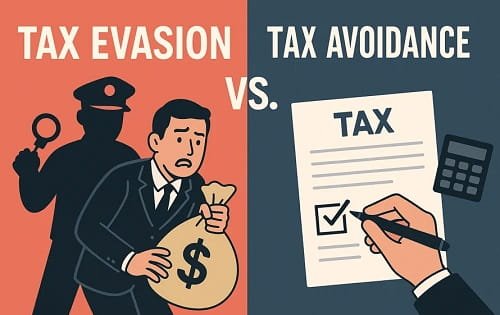
In U.S. law, the difference between tax avoidance and tax evasion is simple but powerful. One is a smart and legal way to reduce your tax bill. The other is a serious crime that can lead to fines, penalties, and even prison.
As of 2026, the Internal Revenue Service (IRS) continues to draw a clear line between the two based on one key factor: intent. Are you following the law to save money—or trying to hide income and mislead the system?
Let’s break it down in a clear, practical way.
1. Tax Avoidance: The Legal Strategy
Tax avoidance is completely legal. It simply means arranging your finances in a way that reduces your tax burden—using rules already written into the law.
What It Means
- Using deductions, credits, and exemptions legally
- Planning your finances to minimize taxes
- Staying fully transparent with the IRS
Legality
- 100% legal and encouraged
The tax system is designed with incentives. If you use them properly, you’re doing exactly what the law allows.
Common Examples
Retirement Contributions
- Putting money into a 401(k) or IRA
- Lowers your taxable income
Deductions
- Mortgage interest deduction
- Business expense deductions
Tax Credits
- Child Tax Credit
- Education credits
Tax-Advantaged Investments
- Municipal bonds (often tax-free at federal level)
Goal
To legally pay the lowest possible tax by following the rules.
2. Tax Evasion: The Criminal Act
Tax evasion is the opposite. It involves deliberately hiding or falsifying information to avoid paying taxes.
What It Means
- Lying about income
- Hiding assets
- Manipulating records
Legality
- Illegal (Federal felony)
Common Tactics
Underreporting Income
- Not reporting cash earnings
- Hiding side business income
- Ignoring offshore interest
Inflating Expenses
- Claiming personal trips as business expenses
- Reporting fake charitable donations
Hiding Assets
- Using offshore accounts
- Creating shell companies
Sham Transactions
- Labeling income in misleading ways
- Structuring fake deals to reduce tax
Core Issue
Tax evasion is about deception. That’s what makes it criminal.
3. Key Differences at a Glance
| Feature | Tax Avoidance | Tax Evasion |
| Legality | Legal | Illegal |
| Intent | Transparent | Deceptive |
| IRS View | Smart planning | Fraud |
| Method | Using tax rules | Breaking tax rules |
| Outcome | Lower tax bill | Penalties, prison |
| Documentation | Accurate records | Fake or hidden records |
4. The Gray Area: Abusive Tax Avoidance
Not everything is black and white. There’s a middle zone that the IRS watches closely.
What Is It?
- Complex strategies that technically follow the law
- But exist only to reduce taxes without real purpose
Example
- Creating fake business structures
- Moving money in circles with no real economic activity
IRS Position (2026)
If a transaction:
- Has no real business purpose
- Exists only to avoid tax
Then:
- It may be reclassified as tax evasion
Key Idea
It’s not just about what you do—it’s about why you do it.
5. Legal Consequences of Tax Evasion
If the IRS proves intentional fraud, the penalties are severe.
Criminal Penalties
- Up to 5 years in prison per offense
Fines
- Up to $250,000 for individuals
- Up to $500,000 for corporations
Civil Penalties
- Fraud penalty of 75% of unpaid tax
Additional Costs
- Legal fees
- Court costs
- Damage to reputation
Real Impact
Tax evasion cases can:
- Destroy businesses
- End careers
- Lead to long-term financial damage
6. Mistake vs Fraud: The IRS Perspective
The IRS does not treat all errors the same.
Honest Mistake (Negligence)
- Miscalculation
- Missing a form
- Incorrect entry
Result:
- Pay owed tax
- Interest
- Around 20% penalty
Fraud (Intentional Evasion)
- Hiding income
- Creating fake records
- Lying on returns
Result:
- Criminal investigation
- Severe penalties
Key Difference
- Mistake = Error
- Evasion = Intent
7. How to Stay on the Right Side of the Law
Avoiding trouble with taxes isn’t complicated—but it requires discipline.
Best Practices
Report All Income
- Even small or cash-based income
Keep Proper Records
- Receipts
- Bank statements
- Tax documents
Avoid “Too Good to Be True” Schemes
- Offshore loopholes
- Fake deductions
- Aggressive tax shelters
Consult Professionals
- Tax advisors
- Certified accountants
Final Thoughts
The difference between tax avoidance and tax evasion comes down to one word: honesty.
- Tax avoidance = working within the system
- Tax evasion = trying to cheat the system
In 2026, the IRS is more data-driven than ever. With advanced tracking and global financial reporting, hiding income has become much harder—and much riskier.
The smart approach is simple:
- Use legal strategies
- Stay transparent
- Keep proper records
Because saving money on taxes is smart—but risking prison for it never is.