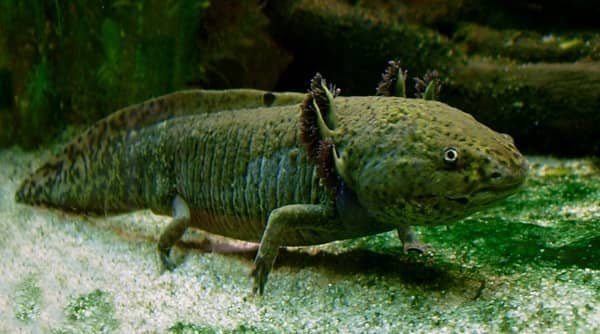
Axolotls have moved from scientific laboratories and specialist aquariums into the mainstream pet trade because of their unusual appearance and fully aquatic lifestyle. They may look like ordinary aquarium pets, but U.S. law is more complicated. An axolotl can be legal in one state, permit-controlled in another, and prohibited somewhere else.
For many Americans, private ownership of a captive-bred axolotl is legal. Important exceptions come from state wildlife rules, import restrictions, and newer federal disease-control regulation. Before ordering one online or transporting one, buyers should check both the source and destination laws.
Is There a Federal Ban on Owning Axolotls?
There is no general federal ban on simply possessing an axolotl as a household pet. However, federal law now regulates the species because axolotls belong to the genus Ambystoma.
In 2025, the U.S. Fish and Wildlife Service added Ambystoma and other salamander genera to the federal injurious-wildlife list under the Lacey Act to reduce the risk of Batrachochytrium salamandrivorans, or Bsal, a deadly salamander fungus.
The federal listing does not prohibit ordinary ownership, captive breeding, sale, or purchase where state law allows it. It does restrict importation into the United States and certain movements involving Hawaii, Puerto Rico, the District of Columbia, or U.S. territories without authorization. Movement between states within the continental United States is not generally prohibited by this listing.
Are Axolotls Legal in California?
California is one of the clearest examples of a state where ordinary pet ownership is not allowed. State regulations treat nonnative members of the genus Ambystoma as restricted animals, which includes the Mexican axolotl, Ambystoma mexicanum.
California requires a restricted-species permit for possession, importation, transportation, or other regulated activities involving listed animals. Those permits are for limited authorized purposes rather than routine pet keeping. Buying an axolotl legally elsewhere does not make it lawful to bring one into California.
Arkansas Now Prohibits New Axolotl Ownership
Arkansas has also taken a strict position. The Arkansas Game and Fish Commission placed axolotls on its Prohibited Captive Wildlife Species list in May 2024.
People who already had an axolotl before the rule change were allowed to register it and keep it for life. The registration deadline was June 30, 2025. New axolotls may no longer be obtained for ordinary private possession in Arkansas.
Do Some States Allow Axolotls With a Permit?
Yes. Maine lists the axolotl as a Category 2 Restricted Species and requires captive-bred origin. Category 2 animals fall under the state’s captive-wildlife permitting system rather than being unrestricted pets. Approval should be obtained before acquisition.
New Jersey also regulates many exotic and nongame amphibians through its Individual Hobby Permit system. A buyer of a regulated amphibian may need to apply for the appropriate permit and provide documentation showing where the animal came from.
What About Virginia?
Virginia shows how these laws can change. The Mexican axolotl once required a special exotic-animal permit there, but Virginia removed it from that list in 2021 after determining that its earlier inclusion was inadvertent.
The current Virginia rule specifically excludes Ambystoma mexicanum from the permit requirement that applies to other mole salamanders on the state’s undesirable-species list. Other wildlife and import rules can still apply, but the axolotl itself is not treated the same way as the rest of the genus under that particular state restriction.
Can You Buy an Axolotl Online?
Online purchase is not automatically illegal, but the buyer must be able to lawfully possess the animal at the destination. State import rules and the 2025 federal restrictions also matter for foreign imports and federally regulated movements.
Buyers should confirm the scientific species, seller location, destination-state rules, and any permit requirement before paying. A seller’s willingness to ship does not prove that receiving the animal is lawful.
The Bottom Line
Axolotls are legal in many parts of the United States, but not everywhere. California and Arkansas are notably restrictive, Maine uses a permit system, New Jersey regulates many exotic amphibians through hobby permits, and Virginia specifically excludes the Mexican axolotl from one broader salamander restriction.
Federal law does not generally ban keeping an axolotl already lawfully present in the country, but the 2025 injurious-wildlife listing for Ambystoma affects importation and certain cross-jurisdiction movements. Checking current state wildlife rules before purchasing or transporting an axolotl is therefore essential.